


Troupes
and figures
The troupes are the undisputed protagonists of the Patum. Heirs of the ancient medieval Corpus Christi entremeses, they represent a unique symbolic universe where fire, solemnity, satire and the ancient representations of good and evil coexist that, over the centuries, have kept the ritual force of our festival alive.
The Tabal, the Turcs i Cavallets, the Maces i els Àngels, the Guites, the Àliga, the Nans Vells, the Gegants, the Nans Nous and the Plens transcend their material dimension to become a living expression of collective identity. Each troupe has its own personality, a history and a specific way of moving and relating to the rest of the patumaires. A collective heritage that, with love and veneration, the Berguedans have preserved and managed to transmit from generation to generation.
Tabal
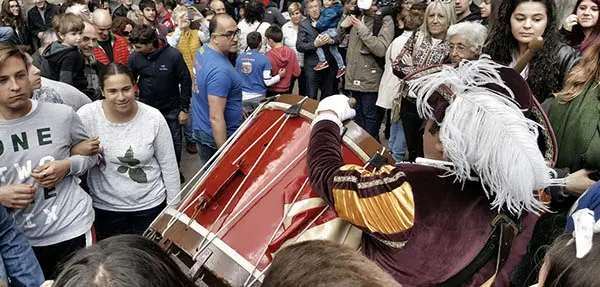
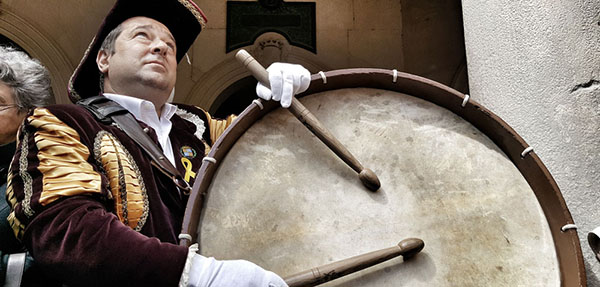
The Tabal (drum). The town crier of the festival. The sound of its beat (pa-tum, pa-tum) has given this festival its name since the late 18th century
The Tabal is the only element of the Patum that participates in each and every one of the festivities. Its presence is constant and in some ways it can be said to preside over and direct them.
Documented since 1621, and reconstructed in 1726, it was the only instrument of the Patum that marked the changing beat of the troupes until the mid-17th century. The Tabal, therefore, did not have any specific symbolism within the performances, but was in charge of directing and coordinating the movements of the various interludes and marked the beat of each of the dances.
The prominence of the Tabal was notably displaced at the end of the 19th century, when musical pieces began to be introduced into the festival.
Nonetheless, the Tabal and the Tabaler (drummer) continue to play an essential role in the Patum. On Ascension Sunday, the Tabal is in charge of announcing the imminent arrival of the Patum throughout Berga. At noon on the eve of Corpus Christi, it precedes the pass of the Gegants (giants) and it also leads the processions, or passes, in the evening on the same day (and the following Saturday). It currently presides over the performances of the Patum in Plaça de Sant Pere from a privileged position and in earlier times used to lead the rest of the Patum’s troupes in the Corpus Christi processions.
If at some point on the Sunday of the Ascension you do not hear the beating of the Tabal announcing the municipal agreement, then you know that there will be no Patum during that year.
turcs i cavallets
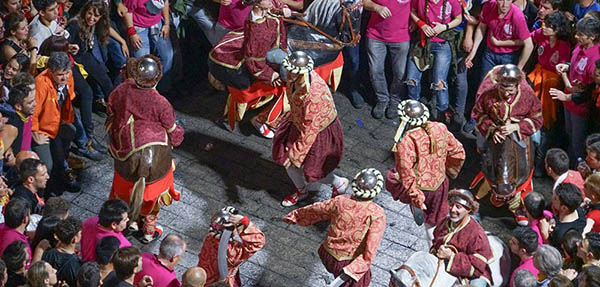
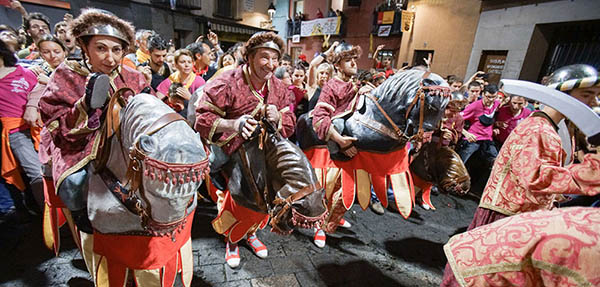
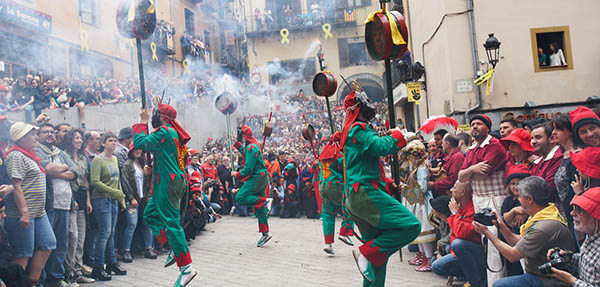
The Turcs (Turks) and Cavallets (little horses): the dance of the Turcs and Cavallets is thought to be one of the oldest in the Patum
Although they may date back to ancient pagan animal husbandry rituals, they now represent the secular struggle between the Cross and the Crescent.
Four Christian knights and four Turkish foot soldiers simulate a battle in which the former are always victorious.
The first known reference can be found in 1621, although the current figures were constructed in 1890. The design of these Berga horses was simple, naive and basic until 1889: the horse’s rump was simulated by a cloth-covered hoop that concealed the rider’s legs, with a tiny wooden head up front and a doll sitting on its rump. The new horses, commissioned from La Perfección in Barcelona, cost 200 pesetas (1.20 euros). Interestingly enough, the costumes of the Turcs and Cavallets, purchased from the same company, were more expensive than the horses themselves: 250 pesetas (1.50 euros).
The Turcs and Cavallets stopped moving to the beat of the Tabal (drum) and in 1890 began to dance to the strains of a musical piece composed by Joaquim Serra i Farriols, who was known as ‘Quimserra’.
maces
The Maces (maces): the eternal struggle between Good and Evil
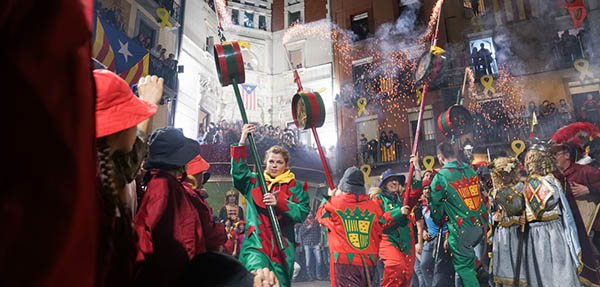
This centuries-old performance, documented since 1621, symbolises the eternal struggle between Good and Evil as portrayed by a childlike battle scene between angels and demons.
The mace consists of a handle topped by a round box that contains stones so that it makes a characteristic sound when it is shaken. They are decorated with evil faces and a gerb (fuet) on top. The Maces are carried by characters dressed as demons, with their faces covered by a mask.
They move through the square as they dance until the gerb explodes. This is when the demons fall to the ground and the angels kill them with their spears and swords.
The Maces were the last troupe to incorporate music, composed by Joan Trullàs in 1963. This music is only performed in the salts (dance rounds) at midday, while in the evening the Maces continue to move as always to the beat of the Tabal (drum).
In olden days, the Maces and Plens (fire demons) were part of the same performance representation, which was that of the demons
angels
The Àngels (angels): representatives of Good struggling against Evil
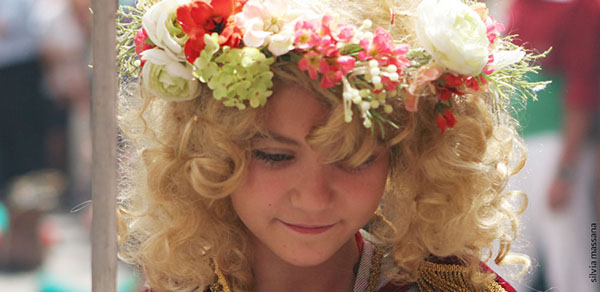
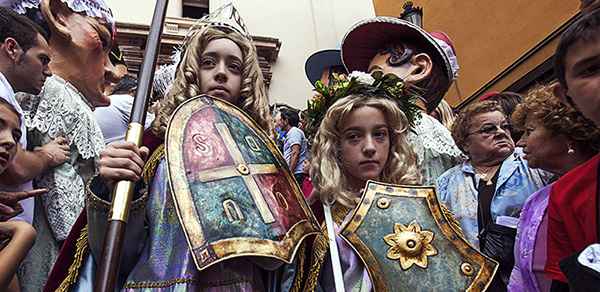
The Àngels are always linked to the Maces (maces) because they are part of the same performance representation. Two representatives of the forces of Good can be found in this representation today: Saint Michael and another angel accompanying him.
The Àngels have been documented since 1621, when only Saint Michael appeared. His assistant finally joined the representation in the first half of the 19th century.
The archangel Saint Michael wore a mask until the first decade of the 20th century and it is currently kept in the Berga Regional Museum
guites
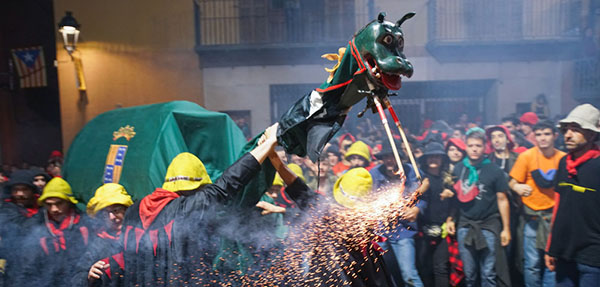
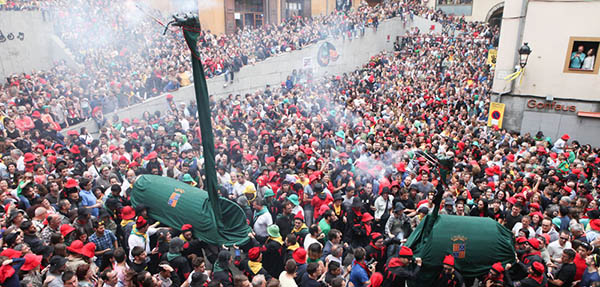
The Guites (mule dragons): one of the oldest elements of the Patum
In the past, they were also known as Mulassa, Mulafera and Mulaguita and they are one of the oldest and most unique elements of the celebration. Together with the Plens (fire demon), the Guites are unique characters in the world, given that their archaic mule form is part of a unique element in the festive bestiary of Spain and the world.
Traditionally, there was only one dragon, the Guita Grossa (big mule dragon), which has been documented since 1621.
The Guites make up one part of the Patum that has changed the least since its origins and retains more basic forms. Although its form has not changed, what has changed is the number of people who carry it, known as the guitaires. Until the beginning of the 19th century, only two people were in charge of carrying the Guita. This number gradually increased and there are currently 28 guitaires accompanying the Guita Grossa and 16 accompanying the Guita Xica (small mule dragon).
The most important change that this troupe has undergone throughout its history has been the introduction of the Guita Xica, popularly referred to as ‘Boja’ (crazy) in 1890, during the process of consolidating the Patum. It was born in Carrer de les Canals (now Marcel·lí Buxadé) in one of the many neighbourhood patums that took place at the time. After requesting the relevant permission from Berga Town Council, it went out to the square by surprise in that year. The feeling it caused among the people of Berga was good enough for it to be accepted and it became part of the Patum together with the Guita Grossa.
The Guites are the only Patum troupe that continues to dance exclusively to the beat of the Tabal (drum). It is thought that its salt (dance round) is the same as in its origins, despite the fact that more than 400 years have passed since the Guita was first mentioned.
aliga
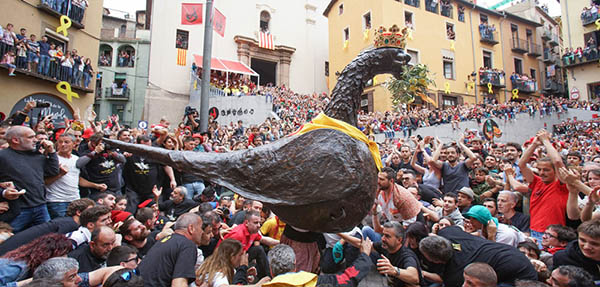
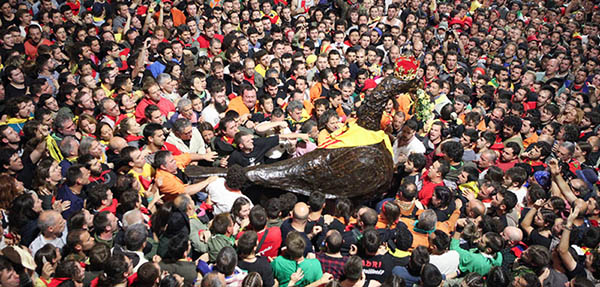
The Àliga (eagle). Performing the people of Berga’s most beloved and majestic dance
The Àliga is undoubtedly the element of Catalonia’s festive bestiary that differs most from the rest. It is the most stately, aristocratic and distinguished figure. The Àliga enjoyed a number of privileges in the past, such as dancing in the church presbytery or leading the Corpus Christi processional custody.
The Patum’s Àliga emerged later than other elements of the festival and its history still remains a great mystery today.
The Berga Town Council decided to incorporate an eagle into the solemnities of the Corpus Christi procession in 1756 and commissioned the carpenter Ramon Roca to build one. This could be the same Àliga, suitably restored and modified, that currently dances in today’s Patum.
Its dance is the most choreographed of all the performance pieces and its music the most distinguished and monumental. The extraordinary score bears many resemblances to a typical Renaissance dance that may have originated in the 16th century, although its melodic line apparently derives from a Gregorian hymn. The melody of the dance of the Àliga in the Patum of Berga has been defined as one of the three ‘greatest’ pieces of Catalan popular music.
nans vells
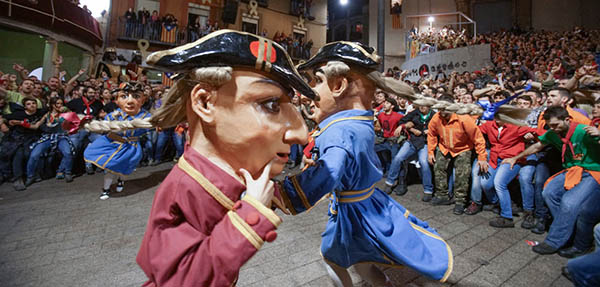
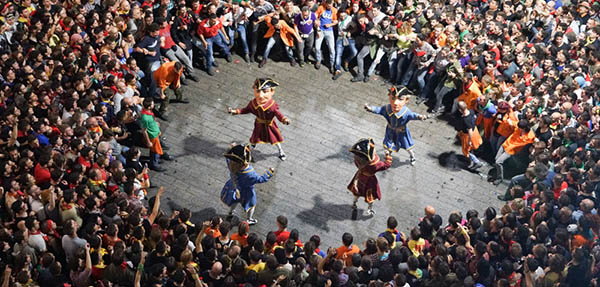
The Nans Vells (old dwarfs). Four characters with tricorn hats and castanets
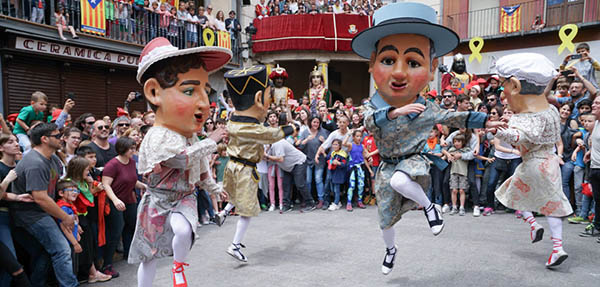
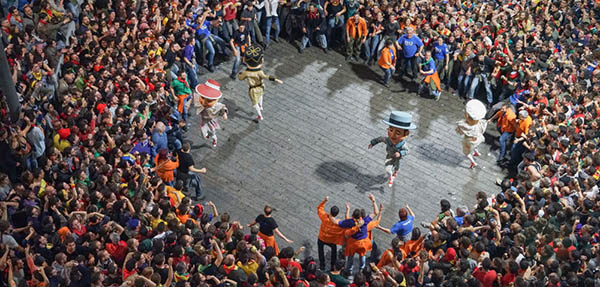
The Gegants (giants) and Nans (dwarfs) are the festive elements that have enjoyed the most popularity over the centuries. There are few towns in Catalonia today that do not have one of these groups and the Patum of Berga is no exception.
The Nans Vells and Nans Nous (new dwarfs) were introduced quite recently to the Patum. The Nans Vells date back to 1853 and were a gift to the town of Berga by Ferran Moragues i Ubach, the first member of parliament from the district of Berga, at a time when these characters were currently in vogue.
There are four male figures with tricorn hats and long wigs that dance and play castanets to the strains of popular melodies, the same tunes that the Gegants dance. The fact that they do not have their own music is perhaps seemingly explained by their surprise appearance in Berga, which forced them to make use of the music that was already being played to perform their dance
gegants
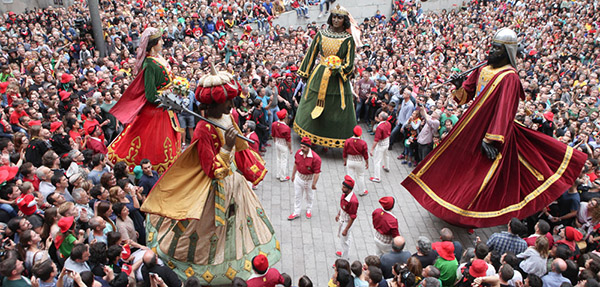
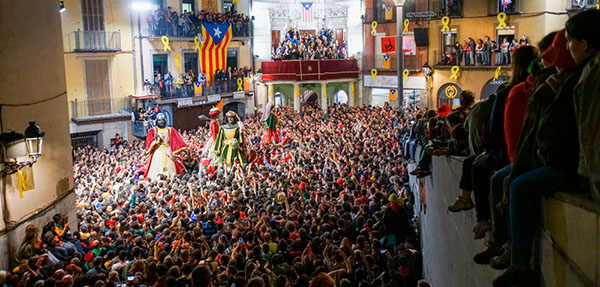
The Gegants (giants). Vanquished former Moorish warlords
The first Gegant of the festival has been documented back to 1622 and the first couple to 1695. Popular tradition, especially since Romanticism, has associated them to vanquished former Moorish warlords.
There are currently two couples dancing together in the Patum: the Vells (old giants), first appearing in 1866 and replacing older giants, and the Nous (new giants), constructed in 1891.
Their dances are mostly adaptations of popular Catalan melodies, although the Berga composers Jaume Sala and Monsignor Marià Miró also wrote dances for these giants.
nans nous
The Nans Nous (new dwarfs). Four fidgety, deformed figures
These figures were introduced in 1890 to replace the Nans Vells (old dwarfs), which were in very poor condition. Luckily, however, the latter were restored and have continued to participate in the Patum until today.
The Nans Nous are two couples, one young and the other old, who dance to the strains of a light, playful melody composed at the end of the 19th century by Joaquim Serra i Farriols, known as ‘Quimserra’, which has become the most popular and disseminated music from the Patum. It appears in the repertoire of many Catalan groups under the title of ‘La Patum de Berga’. In earlier times, they had danced to various tunes that were in vogue at the time, such as rigaudons and those from the Americas.
plens
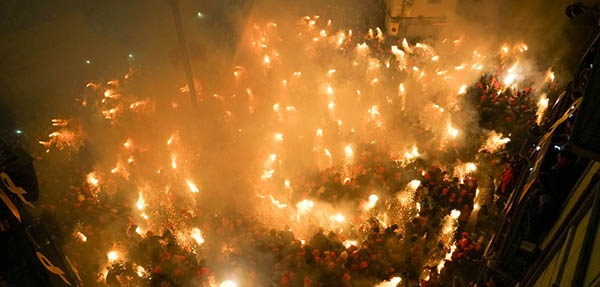
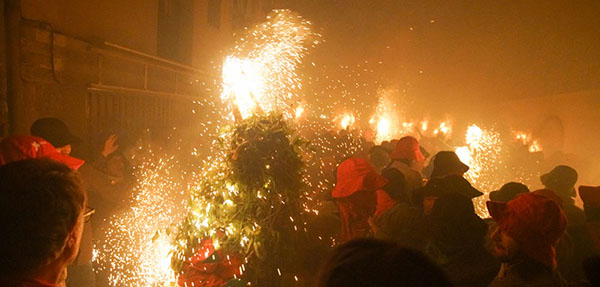
The Plens (fire demons). The climax of the festival
The most spectacular show of the Patum, its culminating moment, the climax of the party.
The Plens have been documented back to 1621 and are believed to owe their name to the fact that they are full of fire. They are, therefore, demons plens de foc (full of fire).
The Plens moved purely to the beat of the Tabal (drum) until the end of the 19th century, but since then they have danced about to the wonderful and exciting music composed by ‘Quimserra’. When the streetlights go out and the music begins, the square becomes an inferno filled with fire from the scores of gerbs exploding at once. A total of 100 Plens, each with nine sets of gerbs, dance and leap about. Each Plen has a companion leading them through the square as they dance and leap about.
It is worth noting that the number of Plens has grown over the centuries. Two demons were documented in the 17th century, while four, eight or sometimes even 12 were dancing and leaping about before the Civil War. To celebrate the special Patum held for the Canonical Coronation of the Virgin of Queralt in 1916, a performance of 16 dancing Plens took place and people believed that there was too much fire in the square and it all posed a danger. This figure rose to 40 later, a number that has now increased to the 100 dancing and leaping about today.
Children's Patum
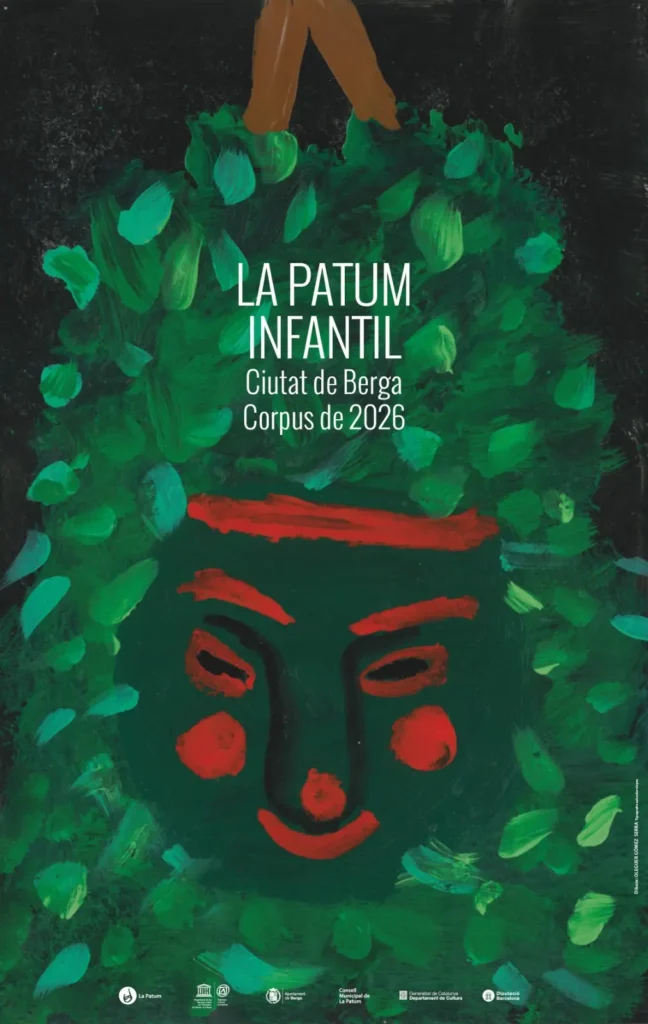
The Patum Infantil (children’s Patum) is celebrated on Corpus Christi Friday, although this activity for Berga’s youngsters begins much earlier. Rehearsals for the Patum Infantil last two weeks, and during this time the children of the town learn the various dances of the festivities, which is why it is known as a ‘escola de patumaires’, or school for Patum people.
On Corpus Christi Friday, the boys and girls of Berga perform their own Patum in Plaça de Sant Pere, which consists of the same elements as the one performed by adults, although smaller in size.
The Patum Infantil begins in the morning with a procession through the streets of Berga and performances of the Patum de Lluïment (ceremonial Patum) and full Patum at noon and in the evening, complete with all the troupes: Tabal (drum), Turcs (Turks) and Cavallets (little horses), Maces (maces) and Àngels (angels), Guites (mule dragons), Àliga (eagle), Nans Vells (old dwarfs), Gegants (giants), Nans Nous (new dwarfs), Plens (fire demons) and Tirabols (final dances).
patum de la llar
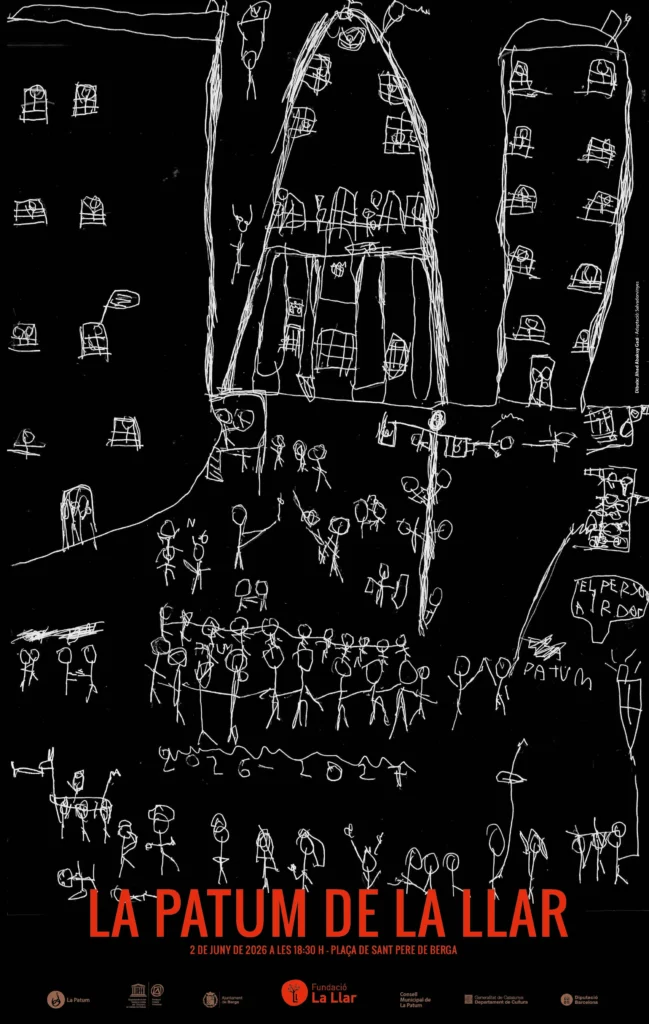
Accessible Patum promoted by professionals and users of the La Llar Foundation. It is a festival open to everyone, but dedicated to and made by people with functional diversity. This initiative ensures adapted popular culture, guaranteeing the participation and enjoyment of the experience of the people involved.
The patum music is performed live by the Band of the Berga Municipal School of Music and musicians from the La Llar Foundation.
Since 2023, it has been held in Plaça de Sant Pere.
music
A key element
Learn more
Music is a key element of the festival and it has been especially so since the late 19th century, when various melodies were incorporated into the Patum. The festival today cannot be conceived without the music performed by the Cobla Pirineu, Cobla Ciutat de Berga and Berga’s Municipal Music School Band.
Most of the music in the Patum is simple, traditional and in some ways uniquely wonderful music. One of the most important musicians of the Patum is Joaquim Serra i Farriols, ‘Quimserra’ (Berga, 1834-1906), composer of the music for the Turcs (Turks) and Cavallets (little horses), Plens (fire demons) and Nans Nous (new dwarfs). He was the one who radically changed the musical landscape of the Patum to make it definitively modern.
Mention should also be made of Ricard Cuadra i Camprubí (Berga 1951-1997), who organised the Forgotten Music of the Patum Concert in 1993 in order to recover old pieces that were no longer being performed. The success achieved with the unintentional reintroduction of works that had been forgotten for decades meant that this concert was held again in 1995 and 1997, helping to recover even more new melodies. His untimely death in 1997 led to the establishment of the Ricard Cuadra Memorial, which continues the work he left unfinished with an annual concert on Holy Trinity Saturday.